When parents separate, child support is often one of the first legal issues that must be addressed. In North Carolina, child support is not based on a simple percentage of one parent’s income. Instead, courts rely on statewide guidelines designed to share financial responsibility fairly between both parents.
Understanding how North Carolina calculates child support can help parents prepare for court, avoid unnecessary delays, and know when legal parentage must first be established.
What Are the North Carolina Child Support Guidelines?
Child support in North Carolina is governed by state law and uniform guidelines established by the Conference of Chief District Court Judges. These guidelines apply in most child support cases and are considered presumptively correct unless a judge finds a valid reason to deviate.
The guidelines focus on several core factors:
- Each parent’s gross income
- The number of children involved
- Custody arrangements and overnights
- Childcare and health insurance costs
- Certain extraordinary expenses
The intent is to ensure children receive consistent financial support that reflects the resources of both parents.
The Income Shares Model Explained
North Carolina uses the Income Shares Model to calculate child support. Under this model, courts estimate the amount parents would have spent on their children if they lived together and then divide that responsibility proportionally between the parents based on income.
Rather than placing the full burden on one parent, the Income Shares Model recognizes that both parents are financially responsible for their child’s needs.
How Child Support Is Calculated
In general, the calculation process includes:
- Combining both parents’ gross monthly incomes
- Referring to a statewide schedule based on income and number of children
- Determining each parent’s percentage share of the total income
- Adjusting for custody time, childcare costs, and health insurance
Courts may adjust the calculated amount if applying the guidelines would be unfair based on the specific facts of the case.
Understanding the Three Child Support Worksheets
North Carolina uses three different worksheets depending on custody arrangements. Selecting the correct worksheet is critical because each one produces a different result.
Worksheet A. Primary Custody
This worksheet is used when one parent has physical custody for 243 or more overnights per year. In these cases, the non‑custodial parent typically pays support to the custodial parent.
Worksheet B. Shared Custody
Worksheet B applies when each parent has the child for at least 123 overnights per year. Because both parents incur daily expenses, the calculation accounts for shared financial responsibility and offsets each parent’s obligation.
Worksheet C. Split Custody
This worksheet is used when parents each have primary custody of different children. It is less common and applies only in specific situations.
What Income Counts for Child Support?
Courts calculate child support using gross income, not take‑home pay. Gross income may include:
- Wages and salaries
- Bonuses and commissions
- Self‑employment income
- Rental or investment income
- Certain benefits such as retirement income
If a parent is voluntarily unemployed or underemployed, the court may assign income based on earning capacity.
When Paternity Must Be Established First
Before a court can order child support, legal paternity must be established. This is especially important when parents were not married at the time of the child’s birth.
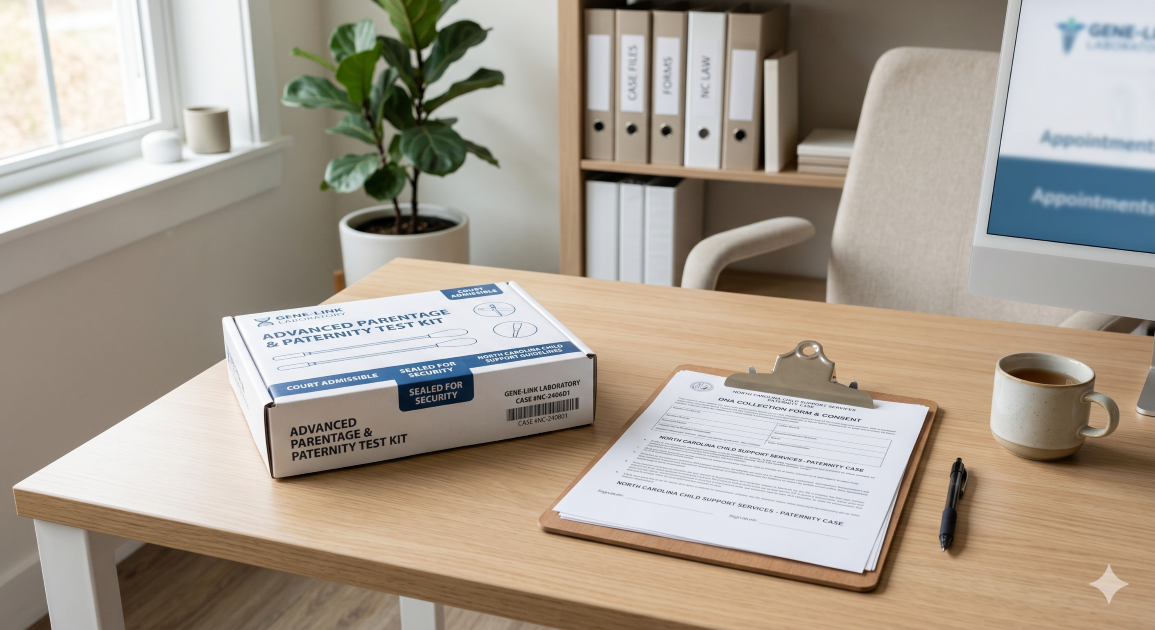
If paternity is disputed or unclear, the court may require court‑admissible DNA testing before moving forward with child support orders. Establishing legal parentage ensures:
- Child support orders are enforceable
- Parental rights and responsibilities are clearly defined
- Children receive financial support from the correct parent
How At Your Door DNA Can Help
At Your Door DNA provides court‑admissible paternity testing with strict chain of custody procedures. We bring professional DNA collection directly to your home, office, or another private location, eliminating the need to visit a clinic.
Our mobile services are designed for families who need reliable answers with discretion, efficiency, and clarity. If child support proceedings require legal proof of paternity, we help ensure testing is completed correctly the first time.
Final Thoughts
North Carolina’s child support guidelines are designed to promote fairness and consistency, but the process depends on accurate information and properly established parentage.
If you are preparing for a child support case and need court‑admissible DNA testing, At Your Door DNA is here to support you with professional, confidential service throughout the Triangle area.
